
The story of the printing press revolution is a testament to the power of innovation and the indelible impact of a single invention on the course of human civilization. This article delves into the remarkable journey of Johannes Gutenberg and his groundbreaking creation that transformed the way information was disseminated and knowledge was democratized.
I. Dawn of a Visionary Idea: Gutenberg’s Genesis
The origins of the printing press revolution lie in the creative mind of Johannes Gutenberg. This section explores the early days that led to the development of this monumental invention.
1. The Inventor’s Quest: Johannes Gutenberg’s Vision
Johannes Gutenberg, a skilled metalworker and entrepreneur, embarked on a quest to revolutionize the process of book production. Inspired by a desire to make knowledge accessible to the masses, Gutenberg’s vision laid the foundation for an epochal transformation.
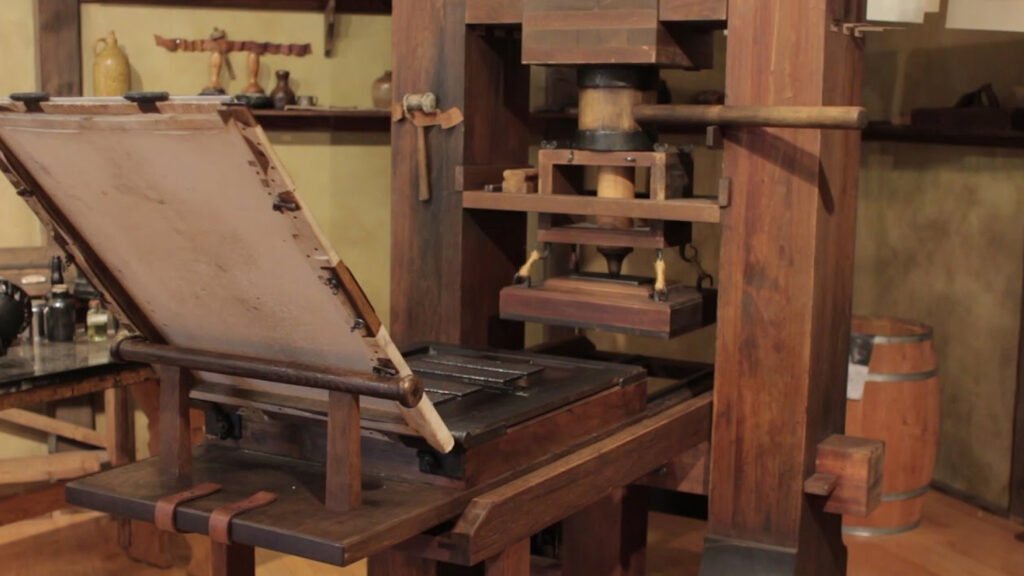
2. Movable Type: The Key to Mass Production
Gutenberg’s innovation hinged on the invention of movable type—a system that allowed individual characters to be arranged and rearranged for printing. This breakthrough paved the way for efficient and standardized production of texts.
II. Birth of the Printing Press: A Technological Marvel
The creation of the printing press marked a paradigm shift in the dissemination of information. This section showcases the birth of the printing press and its immediate impact.
1. The Gutenberg Bible: A Milestone in Printing History
Gutenberg’s masterpiece, the Gutenberg Bible, emerged as the first major book printed using movable type in the mid-15th century. This monumental achievement not only showcased the capabilities of the printing press but also marked the beginning of a new era in communication.
2. Dissemination of Knowledge: The Printing Press’s Reach
The printing press quickly gained traction across Europe, enabling the rapid production and distribution of books, pamphlets, and manuscripts. The newfound ability to replicate texts with unprecedented speed and accuracy transformed education, religion, and public discourse.
III. Revolutionizing Knowledge and Society
The printing press revolution extended far beyond the realm of technology, reshaping the very fabric of society. This section explores the profound societal impact of Gutenberg’s invention.
1. The Democratization of Knowledge: Empowering the Masses
Prior to the printing press, books were rare and often confined to the elite. With the advent of mass production, knowledge became accessible to a broader audience, empowering individuals from all walks of life to engage with literature, philosophy, and scientific discoveries.
2. Cultural Renaissance: Igniting the Age of Enlightenment
The dissemination of knowledge facilitated by the printing press fueled the intellectual currents of the Renaissance and the Enlightenment. Ideas spread across borders, giving rise to critical thinking, scientific inquiry, and a renewed interest in humanism.
IV. Legacy and Continued Impact
Gutenberg’s printing press left an indelible mark on human history, with its influence reverberating through the ages. This section examines the enduring legacy of the printing press and its resonance in modern times.
1. Preservation of Cultural Heritage: Documenting History
The printing press played a crucial role in preserving cultural heritage by standardizing texts and facilitating their replication. It enabled the transmission of ancient manuscripts, sacred texts, and literary classics across generations.
2. Catalyst for Change: Parallel Innovations
The printing press revolution inspired parallel innovations in communication and information dissemination. Newspapers, journals, and later, digital media, owe their existence to Gutenberg’s pioneering spirit.
V. Conclusion: The Printing Press’s Lasting Imprint
The printing press revolution stands as a testament to the potential of human ingenuity to reshape the world. Johannes Gutenberg’s invention unleashed a cascade of transformative effects, from the democratization of knowledge to the acceleration of cultural progress. The printing press remains a beacon of inspiration, reminding us that a single idea, when nurtured and realized, has the power to ignite a revolution that transcends time.

The Mango Flows Editorial Team is committed to creating accurate, insightful, and reader-focused content across business, technology, AI, marketing, finance, and digital innovation. Every article is carefully researched using trusted sources to ensure quality, transparency, and reliability for our readers.