
In this digital era that envelops us, it’s crucial to understand the roots of the technological marvels we now take for granted. The dawn of the digital age marked a pivotal moment in human history, introducing the world to the very first computers that laid the foundation for the vast technological landscape we navigate today. In this comprehensive exploration, we delve into the origins, innovations, and significance of these early computers, illuminating their profound impact on the trajectory of human progress.
The Genesis of Computing: Unveiling the Antecedents
Before the advent of the first computers, a series of intellectual milestones paved the way for this groundbreaking innovation. Notably, the contributions of visionaries like Charles Babbage and Ada Lovelace in the 19th century set the stage for the development of mechanical computation. Babbage’s concept of the “Analytical Engine” and Lovelace’s insightful notes on its potential applications foreshadowed the birth of the digital revolution.
Birth of the First Computers: A Glimpse into History
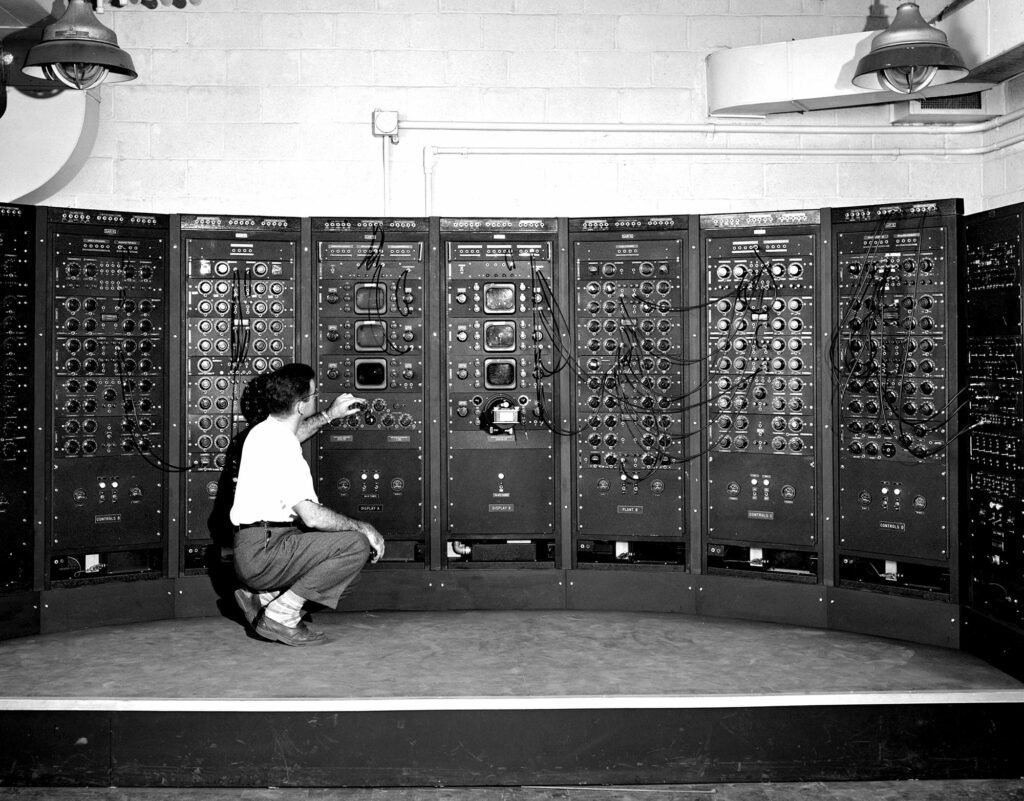
The culmination of years of theoretical groundwork came to fruition in the early to mid-20th century with the birth of the first electronic computers. The Electronic Numerical Integrator and Computer (ENIAC), developed during the 1940s, stands as a monumental achievement. Occupying an entire room, ENIAC employed vacuum tubes and punched cards to perform complex calculations, showcasing the immense potential of electronic computation.
Turing’s Influence and the Turing Machine
Undeniably, the work of Alan Turing played an indispensable role in shaping the course of computing history. His concept of the Turing Machine, a theoretical device capable of executing any algorithmic task, laid the theoretical framework for modern computers. Turing’s groundbreaking ideas not only enriched the intellectual discourse but also laid the foundation for future innovations.
Evolving Architecture: From Vacuum Tubes to Transistors
The march of progress in computing technology led to the gradual transition from vacuum tubes to transistors, marking a significant leap forward in computational efficiency and size reduction. Transistors, tiny semiconductor devices, revolutionized computing by replacing the bulky and power-hungry vacuum tubes. This evolution paved the way for the creation of smaller, faster, and more reliable computers that could be accessible to a wider audience.
The Personal Computer Revolution: Transforming Society
The 1970s witnessed the onset of the personal computer revolution, a transformative era that brought computing power directly into the hands of individuals. Visionaries like Steve Jobs and Steve Wozniak co-founded Apple Inc., introducing the Apple I and II, computers that would redefine the way people interacted with technology. Simultaneously, the rise of Microsoft and its operating system MS-DOS set the stage for a dynamic and competitive tech landscape.
From ARPANET to the World Wide Web: Connecting Humanity
The digital age is incomplete without acknowledging the role of networking technologies. The creation of ARPANET, a precursor to the modern internet, laid the groundwork for global connectivity. Tim Berners-Lee’s invention of the World Wide Web in 1989 further democratized access to information, ushering in an era of unprecedented communication and collaboration.
Contemporary Landscape: Artificial Intelligence and Beyond
The trajectory of computing innovation continued unabated, leading us to the frontiers of artificial intelligence (AI) and machine learning. Computers today are not only capable of intricate calculations but also mimic human cognitive functions. AI-driven advancements in natural language processing, image recognition, and autonomous systems are reshaping industries and creating new possibilities.
The Significance of Understanding Our Technological Roots
As we bask in the convenience and potential of contemporary technology, it is crucial to pay homage to the pioneers who paved the way. Exploring the first computers is not merely an exercise in nostalgia but a way to comprehend the intricate tapestry of human ingenuity. Understanding the genesis of these machines empowers us to make informed decisions in an ever-evolving digital landscape.
Embracing the Future with Informed Perspective
In conclusion, the advent of the first computers heralded a new era of human progress, transcending the boundaries of what was once deemed possible. From the behemoth ENIAC to the sleek and powerful devices of today, the journey of computing has been nothing short of extraordinary. By recognizing the foundations of our digital world, we equip ourselves with the knowledge to navigate the complexities of the present and embrace the boundless possibilities of the future.

The Mango Flows Editorial Team is committed to creating accurate, insightful, and reader-focused content across business, technology, AI, marketing, finance, and digital innovation. Every article is carefully researched using trusted sources to ensure quality, transparency, and reliability for our readers.