
In the grand tapestry of human exploration, the cosmos beckons with its uncharted realms and celestial wonders. As we set our sights on the stars and extend our reach into the vast expanse of space, the propulsion systems that carry us become a critical determinant of our journey’s success. Among these propulsion innovations, ion propulsion emerges as a transformative technology, holding the promise to revolutionize deep space travel. In this article, we embark on an enlightening voyage to unravel the intricate workings, advantages, and boundless potential of ion propulsion as the beacon that fuels the future of our cosmic odyssey.
Beyond Chemical Propulsion: The Essence of Ion Propulsion
1. A Paradigm Shift
Ion propulsion represents a paradigm shift from traditional chemical propulsion systems that rely on expelling propellant at high speeds. Instead, ion propulsion harnesses the power of charged particles—ions—accelerated to extraordinary velocities using electric fields. This fundamental departure enables spacecraft to achieve remarkably higher speeds with significantly less fuel, paving the way for extended missions and explorations into the far reaches of the solar system and beyond.
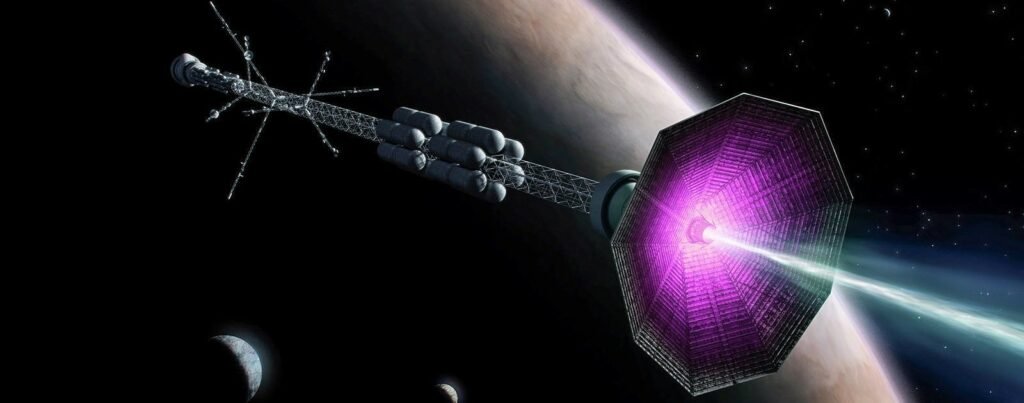
2. Efficient Acceleration
The hallmark of ion propulsion lies in its unparalleled efficiency. While chemical rockets provide a powerful initial thrust but quickly exhaust their fuel, ion engines deliver a continuous and gentle acceleration over extended periods. This gradual increase in speed may seem modest at first, but over time, it accumulates to propel spacecraft to astonishing velocities, enabling faster interplanetary travel and reducing mission durations.
Engineering Elegance: How Ion Propulsion Works
1. Electrifying Acceleration
Ion propulsion relies on the principle of ionization and acceleration. A propellant, often xenon gas, is injected into a chamber where it is ionized, creating positively charged ions. These ions are then accelerated by an electric field, generating a gentle thrust that propels the spacecraft forward. While the individual force of each ion is minuscule, the cumulative effect over time results in remarkable velocities and fuel efficiency.
2. Patience and Precision
The efficiency of ion propulsion comes at the cost of time. Unlike chemical propulsion, which offers rapid acceleration, ion engines operate at a fraction of the thrust but persist for months or even years. This patient approach requires meticulous planning and navigation to optimize trajectories and gravitational assists, ensuring that spacecraft reach their destinations with precision.
The Cosmic Advantages: Ion Propulsion’s Impact
1. Interplanetary Exploration
Ion propulsion’s high efficiency and gradual acceleration make it an ideal choice for interplanetary missions. Spacecraft equipped with ion engines can traverse vast distances, such as the journey to outer planets or the exploration of distant asteroids. These engines enable extended encounters with celestial bodies, allowing scientists to gather in-depth data and images that reshape our understanding of the solar system’s diverse landscapes.
2. Deep Space Endeavors
The allure of ion propulsion extends beyond our planetary neighborhood. For missions targeting the outer reaches of the solar system or venturing into the cosmos between stars, ion engines offer an unparalleled advantage. Their fuel efficiency and extended operation duration make them well-suited for cosmic odysseys that demand resilience, endurance, and the ability to traverse immense distances.
The Odyssey Continues: Ion Propulsion’s Promise
As we peer into the future, the emergence of ion propulsion redefines the boundaries of our cosmic exploration. By harnessing the power of charged particles and mastering the delicate art of patient acceleration, we unlock a realm of possibilities that once seemed out of reach. Ion propulsion stands as a testament to human ingenuity, resilience, and the unyielding desire to traverse the cosmos in search of knowledge, discovery, and the answers that lie beyond.
In the ongoing odyssey of human exploration, ion propulsion takes its place as a transformative force that propels us toward the stars, reshaping the very fabric of our cosmic narrative. With each gentle thrust of charged particles, we inch closer to the frontiers of the unknown, where the secrets of distant worlds, uncharted territories, and celestial wonders await our eager gaze.

The Mango Flows Editorial Team is committed to creating accurate, insightful, and reader-focused content across business, technology, AI, marketing, finance, and digital innovation. Every article is carefully researched using trusted sources to ensure quality, transparency, and reliability for our readers.