
The landscape of industrial automation is undergoing a profound transformation, where the synergy between humans and machines is redefining the boundaries of manufacturing capabilities. This article explores the dynamic realm of human-machine collaboration within industrial automation, delving into its significance, applications, and the potential it holds for driving innovation and productivity.
The Evolution of Collaboration
Traditionally, the concept of automation evoked images of machines performing tasks in isolation, replacing human involvement. However, a paradigm shift has occurred, leading to a realization that the true potential of automation lies in collaborative efforts between humans and machines.
1. Enhanced Efficiency and Precision
Human-machine collaboration capitalizes on the strengths of both entities. Machines bring unmatched precision, speed, and consistency to the table, while human operators contribute critical decision-making skills, creativity, and adaptability. Together, they create a symbiotic relationship that results in enhanced operational efficiency and product quality.
2. Complex Problem Solving
In industrial settings, certain tasks require intricate problem-solving abilities that go beyond the capabilities of automation alone. Human operators, equipped with cognitive skills and contextual understanding, can navigate unforeseen challenges, make quick adjustments, and optimize processes on the fly.
3. Safe and Dynamic Work Environments
Collaboration between humans and machines is particularly advantageous in hazardous or unpredictable environments. Machines can handle dangerous tasks, minimizing human exposure to risks. By working in tandem, humans and machines create a safer working environment while accomplishing tasks efficiently.
Applications of Human-Machine Collaboration
1. Manufacturing and Assembly
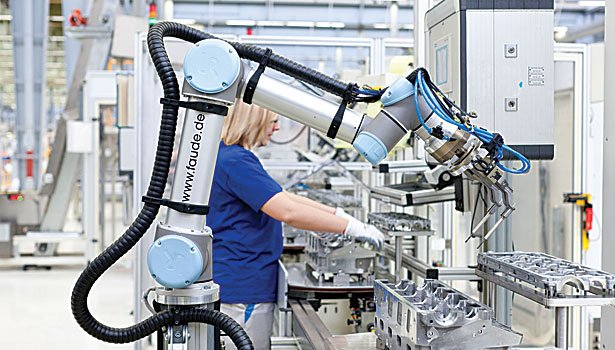
In manufacturing, human-machine collaboration is visible on assembly lines, where robots and humans work side by side. Robots handle repetitive and strenuous tasks, while humans oversee complex decisions, quality control, and intricate assembly steps.
2. Logistics and Warehousing
Collaboration between humans and automated guided vehicles (AGVs) enhances warehouse efficiency. AGVs transport heavy loads, while humans manage inventory, strategize operations, and resolve exceptions.
3. Healthcare and Medical Robotics
In the medical field, robotic surgery and telemedicine showcase human-machine collaboration. Surgeons control robotic arms to perform intricate procedures with precision, leveraging robotic assistance for improved outcomes.
4. Agriculture and Precision Farming
Automated machinery in agriculture can plant, irrigate, and harvest crops. Humans oversee operations, analyze data, and make decisions based on changing environmental conditions.
Challenges and Future Prospects
While human-machine collaboration in industrial automation offers immense potential, it is not without challenges. Interfacing human and machine intelligence, ensuring effective communication, and addressing ethical considerations are vital areas of focus. The future holds promise for advanced cognitive interfaces, improved AI capabilities, and seamless integration between humans and machines.
Embracing the Collaborative Future
The era of human-machine collaboration in industrial automation represents a convergence of capabilities that can drive innovation and shape a more productive and sustainable future. By leveraging the strengths of both humans and machines, industries can achieve unprecedented levels of efficiency, quality, and adaptability.
In conclusion, human-machine collaboration is not a replacement of human involvement but a harmonious partnership that amplifies the potential of industrial automation. Together, humans and machines forge a path towards a new frontier of possibilities, where innovation and progress thrive.

The Mango Flows Editorial Team is committed to creating accurate, insightful, and reader-focused content across business, technology, AI, marketing, finance, and digital innovation. Every article is carefully researched using trusted sources to ensure quality, transparency, and reliability for our readers.