
In the ever-evolving realm of software testing, the pursuit of comprehensive test coverage and optimal test effectiveness remains a top priority for development teams. Data-Driven Test Automation emerges as a powerful strategy that harnesses the potential of diverse data sets and parameterization to enhance the scope, depth, and accuracy of automated tests. In this comprehensive guide, we delve into the world of Data-Driven Test Automation, exploring its techniques and benefits that empower organizations to achieve unparalleled testing excellence.
Understanding Data-Driven Test Automation
Data-Driven Test Automation is a methodology that involves using a variety of data inputs and parameters to execute automated tests. Rather than relying on a fixed set of test scenarios, this approach enables tests to be executed with multiple combinations of input data. By systematically varying inputs, testers can evaluate how software behaves under different conditions and uncover potential defects that might otherwise go unnoticed.
Benefits of Data-Driven Test Automation
- Enhanced Test Coverage: Data-driven tests encompass a wider range of scenarios, allowing for a more comprehensive exploration of software behavior.
- Realistic Validation: Tests using real or simulated data scenarios mimic actual usage, providing a more accurate validation of software functionality.
- Efficient Bug Detection: Different data inputs often uncover unique bugs and edge cases, facilitating early detection and resolution.
- Reusable Test Logic: Parameterization separates test logic from test data, promoting code reusability and reducing duplication.
- Adaptability to Change: When data or requirements change, parameterized tests can be easily updated without modifying the underlying test logic.
Key Techniques for Data-Driven Test Automation
1. Test Data Generation: Realism and Diversity
Generating meaningful and diverse test data is paramount to the success of Data-Driven Test Automation. Tools like Faker and DataFactory assist in creating realistic data scenarios, spanning a wide spectrum of inputs and edge cases. This technique ensures that tests accurately represent real-world usage scenarios.
2. Parameterization and Dynamic Inputs
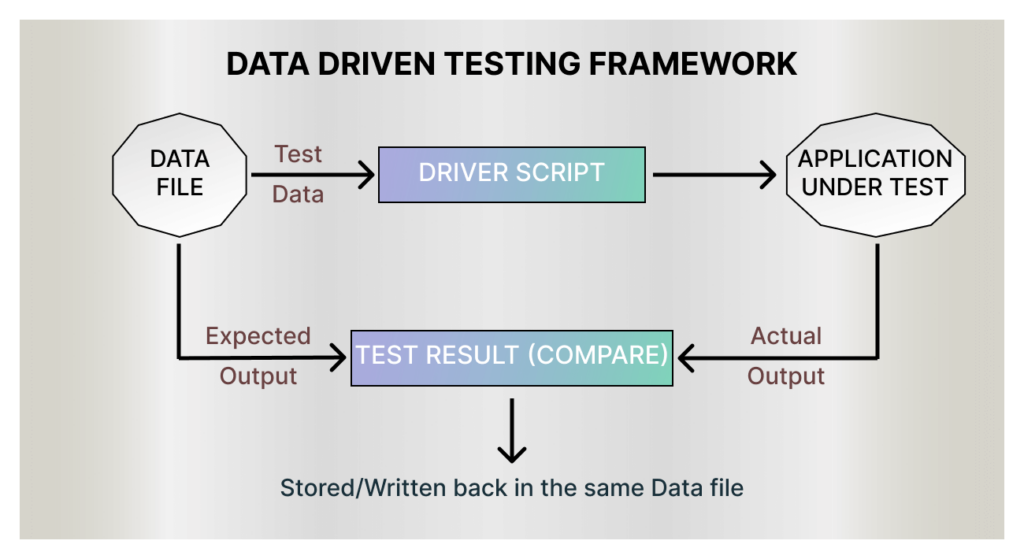
Parameterization involves separating test logic from test data, allowing inputs to be provided externally. This approach enables testers to execute the same test logic with different data sets, enhancing test coverage. Dynamic inputs can be sourced from CSV files, databases, or APIs, offering flexibility and adaptability.
3. Data-Driven Testing Frameworks
Data-Driven Testing frameworks, such as TestNG in Java or pytest in Python, facilitate the execution of tests with varying data inputs. These frameworks streamline the process of defining and executing parameterized tests, enabling testers to focus on test scenarios rather than the underlying implementation.
4. Exploratory Testing with Data Variability
Exploratory testing takes on new dimensions when combined with Data-Driven Test Automation. Testers can explore different aspects of the software by systematically introducing varying data inputs. This technique uncovers unique defects and edge cases that might otherwise remain hidden.
5. Reporting and Analysis
Effective reporting and analysis of Data-Driven Test Automation results are crucial for identifying patterns, trends, and potential issues. Tools like Allure or ExtentReports offer visually appealing and insightful reports that aid in understanding software behavior under diverse data scenarios.
Conclusion
Data-Driven Test Automation emerges as a game-changing strategy in the pursuit of software quality and reliability. By harnessing the power of diverse data sets and parameterization, development teams can significantly elevate the effectiveness and coverage of their automated tests.
Through techniques such as realistic test data generation, parameterization, dynamic inputs, data-driven testing frameworks, and exploratory testing, organizations can uncover defects, validate software behavior, and ensure optimal functionality across a spectrum of usage scenarios.
In a competitive digital landscape where user satisfaction is paramount, Data-Driven Test Automation stands as a cornerstone of success. Organizations that prioritize test coverage, accuracy, and adaptability through parameterization are well-equipped to deliver software that not only meets but exceeds user expectations.

The Mango Flows Editorial Team is committed to creating accurate, insightful, and reader-focused content across business, technology, AI, marketing, finance, and digital innovation. Every article is carefully researched using trusted sources to ensure quality, transparency, and reliability for our readers.