
In today’s fast-paced business landscape, where efficiency and innovation are the driving forces behind success, the integration of Artificial Intelligence (AI) and Robotic Process Automation (RPA) has emerged as a transformative solution. The fusion of these two cutting-edge technologies creates a powerful automation ecosystem that propels businesses towards unparalleled levels of operational excellence and optimal performance.
Unveiling the Synergy: AI Meets RPA
A Symbiotic Partnership
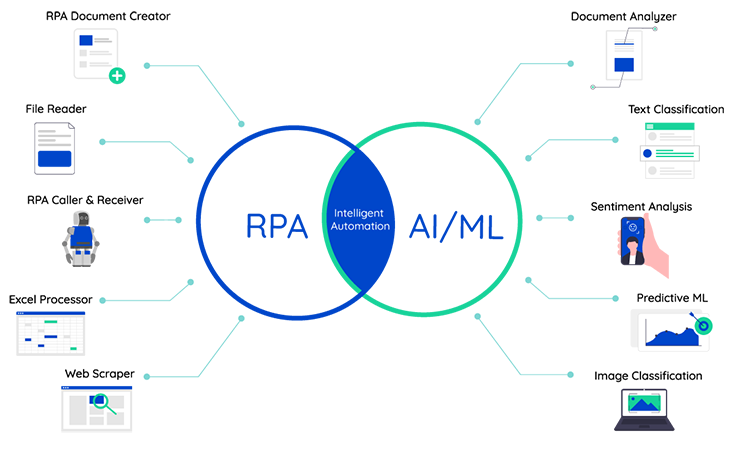
At its core, AI is the simulation of human intelligence processes by machines, enabling them to analyze data, make informed decisions, and learn from experiences. RPA, on the other hand, is designed to automate repetitive, rule-based tasks by employing software robots. The marriage of AI and RPA presents an opportunity to combine AI’s cognitive abilities with RPA’s efficiency, ultimately forming a symbiotic partnership that can revolutionize business operations.
Transforming Mundane Tasks
One of the most significant advantages of integrating AI and RPA is the liberation of human resources from mundane and repetitive tasks. These technologies work in tandem to streamline workflows, allowing employees to focus on higher-value tasks that require creativity, critical thinking, and problem-solving skills. As AI continuously learns and adapts, it enhances the capabilities of RPA by providing intelligent insights that refine automation processes.
The Benefits of AI and RPA Integration
Enhanced Decision-Making
AI’s ability to analyze vast amounts of data in real-time equips businesses with actionable insights for informed decision-making. When AI is integrated into the RPA framework, it empowers the automation system to adapt dynamically based on changing circumstances. This synergy enables organizations to make data-driven decisions with confidence, thereby optimizing overall business performance.
Unparalleled Accuracy and Efficiency
RPA is renowned for its precision and speed in executing tasks. However, when bolstered by AI’s cognitive capabilities, this efficiency reaches unparalleled heights. AI-powered RPA systems can not only complete tasks faster but also with unmatched accuracy. By minimizing errors and reducing manual intervention, businesses can achieve new levels of operational excellence and customer satisfaction.
Scalability and Flexibility
The integration of AI and RPA creates a versatile automation ecosystem that can seamlessly scale to meet evolving business demands. Traditional RPA systems might struggle with complex or unstructured data, limiting their applicability. AI bridges this gap by enabling RPA to process diverse data types, making the entire system more adaptable and responsive to a broader range of tasks.
Continuous Improvement and Learning
AI’s ability to learn from patterns and experiences complements RPA’s iterative nature perfectly. As processes are automated, AI analyzes outcomes and identifies areas for optimization. This continuous improvement loop enhances RPA’s capabilities over time, making the automation ecosystem increasingly intelligent and efficient.
Implementing the Future: Practical Use Cases
Customer Service Excellence
The integration of AI and RPA offers significant advantages in the realm of customer service. Chatbots powered by AI can engage with customers in real-time, providing accurate responses and solutions. RPA, in turn, can process and execute customer requests seamlessly, ensuring swift and error-free transactions. The result is an enhanced customer experience with reduced wait times and personalized interactions.
Data Entry and Processing
Data entry, a labor-intensive and error-prone task, is ripe for automation. AI-powered optical character recognition (OCR) technology can accurately extract data from various sources. RPA can then validate, process, and input this data into relevant systems, minimizing human intervention and significantly reducing the risk of errors.
Predictive Analytics
The amalgamation of AI and RPA enables businesses to leverage predictive analytics for informed decision-making. By analyzing historical data patterns and current trends, AI-powered RPA systems can provide insights into market dynamics, customer preferences, and resource allocation. This foresight empowers businesses to proactively adapt their strategies and stay ahead of the competition.
Embracing the Future of Automation
The integration of AI and RPA marks a pivotal moment in the evolution of business automation. By combining AI’s cognitive prowess with RPA’s efficiency, organizations can unlock new levels of productivity, accuracy, and innovation. This dynamic partnership empowers businesses to optimize their processes, elevate customer experiences, and drive sustainable growth in an ever-changing market landscape.

The Mango Flows Editorial Team is committed to creating accurate, insightful, and reader-focused content across business, technology, AI, marketing, finance, and digital innovation. Every article is carefully researched using trusted sources to ensure quality, transparency, and reliability for our readers.